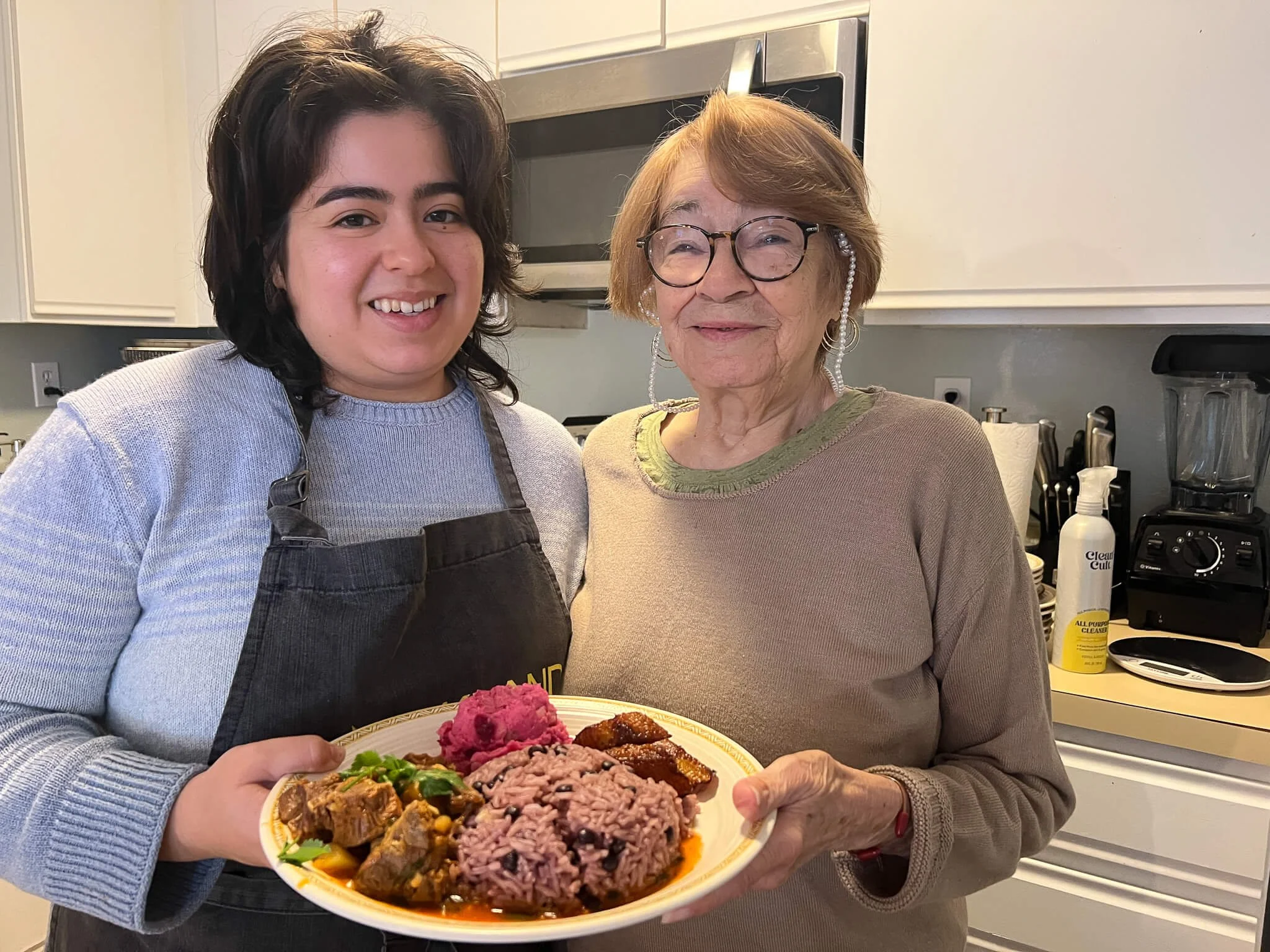
Dani
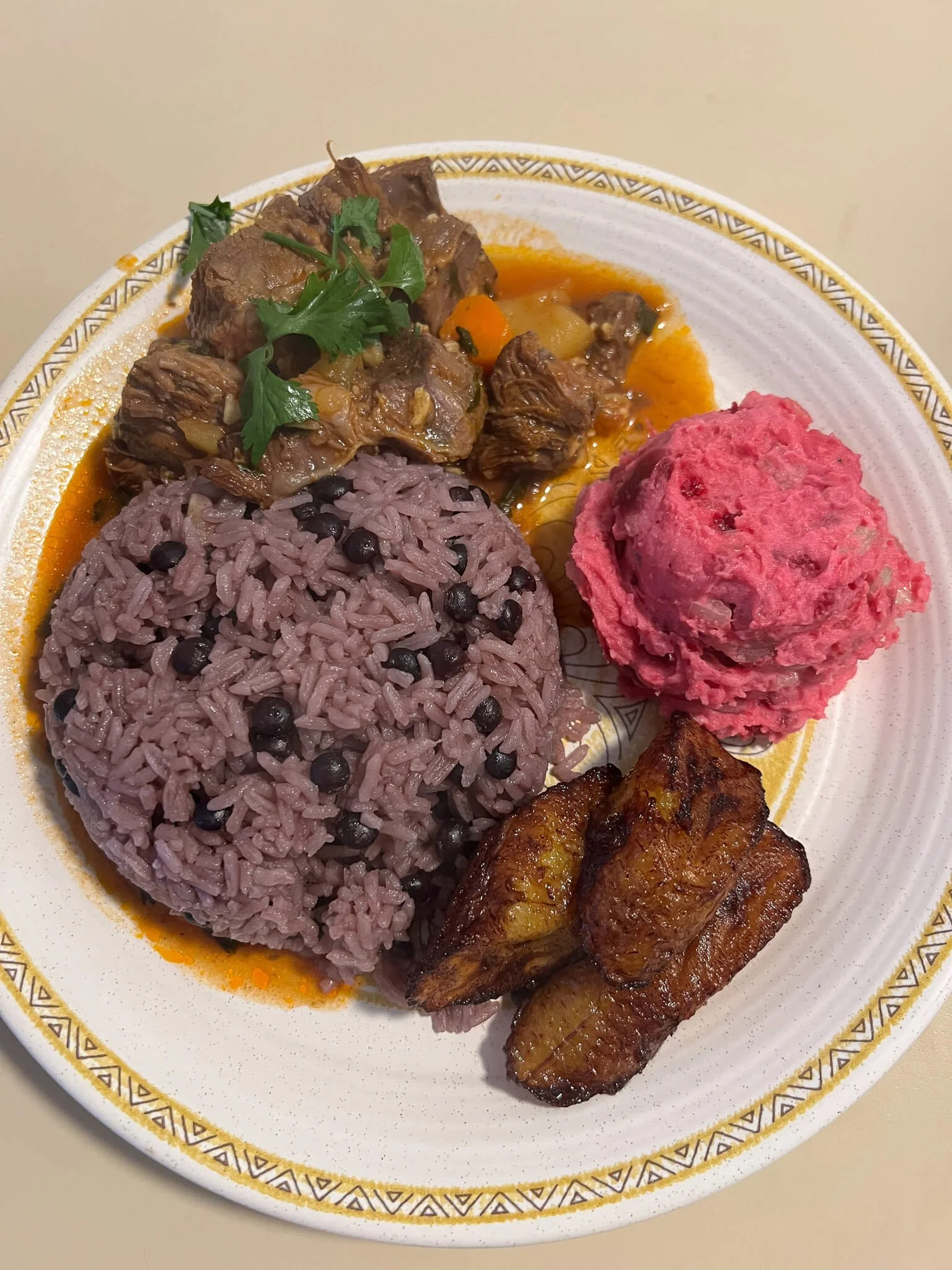
Serving: Arroz con Guandú, Plátanos Maduros, Ensalada de Feria (Ensalada de Papas y Remolachas)
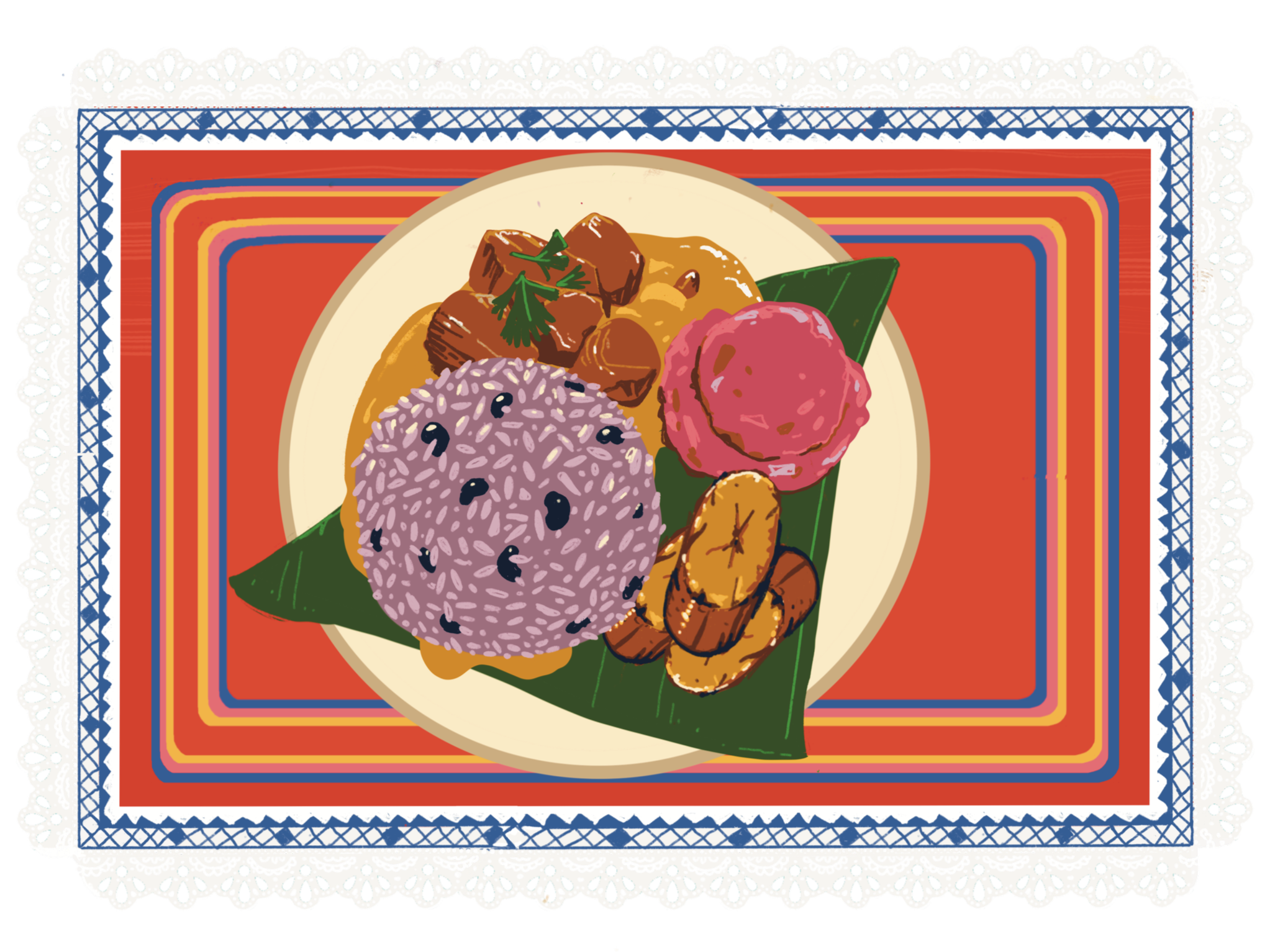
Artwork by Rami KD
Hear their story
Read the Transcript
-
Dani: Excuse me.
Beny: Mmhm.
Dani: That looks so delicious.
Beny: At Your service.
Dani: People say “a la orden” a lot in Panama when you make your order at a restaurant. Somebody will say, “A la orden,” like at your service. It’s kind of dramatic.
Dani: One of the earliest memories that I have of making food is being in my mom's house, and I remember my grandma cooking in the kitchen.
So usually I like to plate the rice first, so do that..
My name is Dani or Dani. I consider myself to be a Panamanian American millennial, I guess. Right now one of the big projects that I'm working on is Chiricana Cocina Panameña where I've been exploring a lot of my own family's recipes and Panamanian food traditions.
My grandmother, Benedicta or Beny, she's always been really generous with her recipes, and I know that a lot of people, they struggle with getting recipes from their family members, especially women family members because that's like jewelry. It's so special.
Dani: Bollos are cooked with plant stalk leaves, right?
Beny: Yes, if you want, it can be like that too.
Dani: And what else?
Dani: So “chiricana” is a word that's used to describe a woman who's from Chiriquí.
Beny: I was born in Chiriquí, in a town. It’s called… it was the countryside
Dani: She is talking about how in her childhood she grew up in rural Panama. Her dad had a farm and he grew livestock so they had a very rural lifestyle.
My grandma would always tell us stories of how she would just like get into fights with people and they would call her “La Chiricana Brava,” which I think is really funny now because I see her and she's just like this sweet old lady.
Dani: When did you come to the United States and why?
Beny: Ah… you know, well, my daughter hadn’t gotten married, you don’t really see that anymore…
Dani: My grandmother, she actually immigrated to the U.S. after my mom did. My mom, her first husband, was in the US Air Force. My mom was working at the Panama Canal and they came to the US. After my mom got divorced,, she came to California where she met my dad, and then she had my sister and I in San Jose, California. My grandma moved afterwards. It’s like on one hand, I feel sad for her. I wish that she didn't have to leave her country because she loves Panama. She's always thinking about when's the next trip, but the situation was just really tough for her. I'm grateful that my mom wanted me to have a better life here and you know I guess get away from all the problems that they were having, as a family.
Dani: Is it painful to be here?
Beny: Yes, sometimes I get melancholic…
Dani: She has melancholy.
Beny: Sad.
Dani: And sad.
Beny: But, good.
Dani: She really was our second mom in a lot of ways. We spent most of our time with her as kids.
Dani: Grandma, do you want to introduce what we made?
Beny: Ah yes, here they are—fried ripe plantains, nicely golden brown.
Dani: We have over here some plátano maduro. And that’s just classic ripe fried plantain.
Beny: And this is Panamanian Chiricano arroz con guandú.
Dani: This is really special: arroz con guandú. So this is a Panamanian classic. People usually eat this during the holidays.
Beny: And here is the braised beef shank. It’s hot.
Dani: And then we have chamorro guisado which is like a beef shank stew.
Beny: And here is potato salad—it has beets and celery…
Dani: This is really fun. This is a Panamanian potato salad. It has beets. People see it, they're like, “This is really strange. I've never seen a pink potato salad before. Is it Pepto-Bismol in it or something?” I’m like, “No, it just has beets. It's really good.”
Beny: Buen provecho.
Dani: Buen provecho. It means to enjoy the food. Hope you enjoy the food.
Dani: I had never met another Panamanian person until 2021. And so for me, like starting this food project was about combating that kind of loneliness that I felt. I draw from my mom and my grandma, and my tía, all who have had really extraordinary lives and really interesting stories to tell. Everything that I do I feel like is a representation of them and their creative spirit.
Beni: I’ll give you a very delicious, very Panamanian plate
Dani: She says, “This is a very typical Panamanian plate. It’s very good, and I hope you come back to try more food!”
Beni: I hope you come back.
-
Dani: Con permiso.
Beny: Mmhm.
Dani: Qué rico se ve.
Beny: A la orden.
Dani: La gente dice “a la orden” mucho en Panamá cuando haces tu pedido en un restaurante. Alguien te dice “a la orden”, como “a tu servicio”. Es un poco dramático.
Dani: Uno de los primeros recuerdos que tengo de hacer comida es estar en la casa de mi mamá, y recuerdo a mi abuela cocinando en la cocina.
Dani: Entonces, normalmente me gusta servir primero el arroz, así que hago eso…
Dani: Mi nombre es Dani. Me considero una millennial panameña-estadounidense, supongo. Ahora mismo, uno de los proyectos más grandes en los que estoy trabajando es Chiricana Cocina Panameña, donde he estado explorando muchas de las recetas de mi propia familia y las tradiciones culinarias panameñas.
Mi abuela, Benedicta o Beny, siempre ha sido muy generosa con sus recetas, y sé que muchas personas tienen dificultades para obtener recetas de sus familiares, especialmente de las mujeres, porque eso es como joyería. Es algo muy especial.
Dani: Los bollos se cocinan con hoja de tallo, ¿verdad?
Beny: Sí, uno quiere, puede ser también.
Dani: ¿Y qué más?
Dani: Entonces, “chiricana” es una palabra que se usa para describir a una mujer que es de Chiriquí.
Beny: Yo nací en Chiriquí, en un pueblo. Se llama… ¿era un campo, no? Pero sí…
Dani: Ella está hablando de cómo en su infancia creció en una zona rural de Panamá. Su papá tenía una finca y criaba ganado, así que tenían un estilo de vida muy rural.
Mi abuela siempre nos contaba historias de cómo se metía en peleas con la gente y le decían “La Chiricana Brava”, lo cual ahora me parece muy gracioso porque la veo y es como esta dulce abuelita.
Dani: ¿Cuándo viniste a los Estados Unidos y por qué?
Beny: Ah… sabe que, bueno, mi niña no se había casado, ya no se ve…
Dani: Mi abuela en realidad emigró a Estados Unidos después de mi mamá. El primer esposo de mi mamá estaba en la Fuerza Aérea de Estados Unidos. Mi mamá trabajaba en el Canal de Panamá y vinieron a Estados Unidos. Después de que mi mamá se divorció, se fue a California donde conoció a mi papá, y luego tuvo a mi hermana y a mí en San José, California. Mi abuela se mudó después. Por un lado, me siento triste por ella. Desearía que no hubiera tenido que dejar su país porque ama Panamá. Siempre está pensando en cuándo será el próximo viaje, pero la situación fue muy difícil para ella. Estoy agradecida de que mi mamá quisiera que yo tuviera una mejor vida aquí y, supongo, alejarme de todos los problemas que tenían como familia.
Dani: ¿Te duele mucho no estar allá?
Beny: Sí, a veces me pongo melancólica…
Dani: Tiene melancolía.
Beny: Como triste…
Dani: Y triste.
Beny: Pero, bueno.
Dani: En muchos sentidos, ella realmente fue nuestra segunda mamá. Pasábamos la mayor parte del tiempo con ella cuando éramos niñas.
Dani: Abuela, ¿quieres presentar lo que hicimos?
Beny: Ah sí, aquí están los plátanos maduros fritos, bien doraditos.
Dani: Aquí tenemos plátano maduro. Es el clásico plátano bien maduro frito.
Beny: Y este es el arroz con guandú chiricano panameño.
Dani: Esto es muy especial: arroz con guandú. Es un clásico panameño. La gente suele comerlo durante las fiestas.
Beny: Y aquí está la carne guisada de chamorro. Está caliente.
Dani: Y luego tenemos chamorro guisado, que es como un estofado de jarrete de res.
Beny: Y aquí está la ensalada de papa, con remolacha, tiene apio…
Dani: Esto es muy divertido. Es una ensalada de papa panameña. Tiene remolacha. La gente la ve y dice: “Esto es muy raro. Nunca he visto una ensalada de papa rosada. ¿Tiene Pepto-Bismol o algo así?” Y yo digo: “No, solo tiene remolacha. Está muy rica.”
Beny: Buen provecho.
Dani: Buen provecho. Significa disfrutar la comida. Espero que disfruten la comida.
Dani: Nunca había conocido a otra persona panameña hasta 2021. Así que para mí, comenzar este proyecto de comida fue una forma de combatir ese tipo de soledad que sentía. Me inspiro en mi mamá, mi abuela y mi tía, quienes han tenido vidas realmente extraordinarias y tienen historias muy interesantes que contar. Todo lo que hago siento que es una representación de ellas y de su espíritu creativo.
Beni: Bueno, te doy un plato bien rico y panameño…
Dani: Ella dice: “Este es un plato muy típico panameño. Está muy rico, ¡y espero que regreses a probar más comida!”
Beni: Espero que regreses.