
Norma
Location: Oakland Federal Building (1301 Clay St, Oakland)
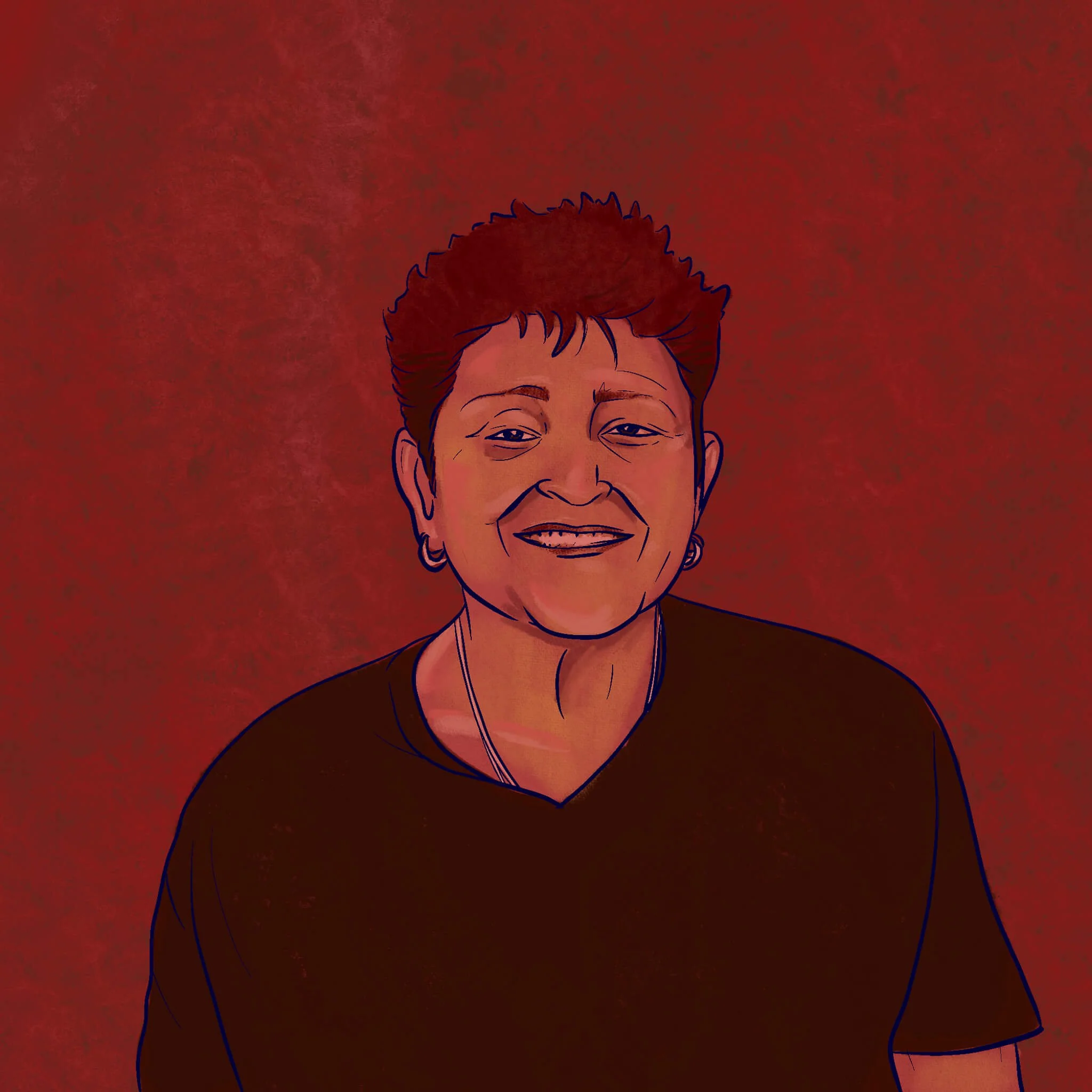
"I used to say I was made out of Chevy truck parts honey. I was tough, real tough."
Norma Austin was born in Corcoran, California in 1955. After getting in trouble she became a union plaster, only the second woman to do so in San Jose. Norma plastered on homes and buildings around San Jose, San Francisco and Oakland, namely the Ronald V. Dellums Federal Building and U.S. Courthouse on 14th and Clay in Downtown Oakland. In 1985 she fell 26 feet on a job site. Through Tai Chi and a deep love of family, Norma’s on a path to healing.
Hear the story
Read the story
-
My name is Norma Austin. I'm a 66 year old female, identifies as lesbian. I was born in Corcoran, California in 1955, which is a–was a small farming town, really tiny. And now the farms are gone and it's a big prison town. Coming from a family of four kids, I made sure that everybody got home in one piece. Coming home from school, just even in the second grade, I had to get in a fight almost every day just to get home because kids are trying to beat you up for entertainment. I grew up on the east side of San Jose, which that was what the activity was then. That's how I learned how to fight. I got in so much trouble and I started getting arrested when I was eight, shoplifting at this Safeway that was close to our house. I got in the habit of taking a little order at school from kids and then getting ahold of that, whatever that was, and then giving it to ‘em for half price. I was an entrepreneur at eight. Yeah. Oh, I continued to do that and other things. The one thing I never got in trouble for was fighting though. That was the activity I did the most. Then I got in a lot of trouble. And then when I was fourteen, my dad put me in kung fu class and that helped everything.
I started getting molested when I was five. That made me want to beat up those bad people. So that became what I did throughout my life. I still do that. If I wasn't physically impaired right now, I would still be doing that. I know that. I mean, one year I got arrested thirteen times in one year man. Wasn't very good at what I was doing. Cause I was on a mission just to just self destruct, you know? And I got sent to prison, California Institution for Women. I did about two and a half years. And I promised myself, I would never, ever do that to myself again because I'm better than that. And I knew it. So, I got outta prison in 1979 and I got the opportunity to work construction. And my brother says, you know, if you work construction, you'll make a lot of money and you'll be too tired to get in trouble. And that phrase right there sold me. So I became a plasterer. I was the second woman to become a union plaster through the union in San Jose. I continued working and then in 1985, November 7th, 1985, I fell. A 26 foot fall. And my feet and hips were higher than my shoulders and head. So I came down on the cement on my upper back and neck. I walked out of the hospital the same day. I didn't break a bone, nothing. I didn't have no bruises, nothing. I used to say I'm made outta Chevy truck parts, honey. I was tough, real tough. I'll put it to you like this, watch this. When I fell, this guy yells out, ‘you could have found a better way to take your birthday off.’ And then I said, ‘fuck you!’ And then I heard somebody else say, ‘oh, she's alright.’ Okay. That's construction talk for, are you okay?
Even though I got hurt, I didn't wear it. I didn't try to show it. Now, it's obvious. It's obvious that I got a lot going on. I got scoliosis so bad that I am seven inches shorter than I used to be. And I feel it. I might have walked away from the accident then, but it's caught up to me now. Now that I'm 66. I've had both my hips replaced. I'm about to replace my left knee, my right shoulder and maybe the left shoulder. I always say, I'm lucky to be complaining about it, you know, but it's true. You know, I'm really lucky to be here and I'm still walking. I still got my brain. So after I got hurt, I started tai chi class. I fell in love with the tai chi. It was an extension of the kung fu. The power I had within myself. I mean, I always knew I was strong, tough, but this power that everybody has inside of them, that people really don't know that exists. It's just incredible. It's affected my life. It's my church. It's my – it washes me.
-
So I became a plasterer. I loved it. I loved it. It was tough work, man. It's satisfying to make something, build something and even make it look ornate. Not just build it, but put some beauty into it. And then when you complete that job, you can look back at it and say, I did that. That's very satisfying. It's there. I mean, I see buildings right now, still downtown Oakland and San Jose and San Francisco that I worked on. There's these twin buildings downtown Oakland on 14th by Clay Street. I worked on both of those buildings right there. I think it was the early ‘80s. That high rise, what I like best about working high, like that is the view. The views were incredible. So when I was working on the very top of those twin buildings, when you get way on the very top, there's a cap. You can walk around up there. And I put the cap up there and I ran this mold that goes throughout the whole building. So that's what I remember doing. I'm the one that ran the mold. So I went around putting all the detail everywhere. And so what I did was I made a wooden mold and then I cut a piece of metal and put that in front of the mold. So it would stay a perfectly straight surface. And then I filed it and made sure that it had no snags or anything. So it was my piece and I took that to work every day. And I ran that throughout the buildings. So that detail's my work.
So I walk up to the board, I start at the highest level, right? And so I climb on the outside of the scaffold with no stairs. They have stairs on them now, I can't believe it. You had to hold your tools in a bucket, right? And it's got several inches of water on the bottom of a five gallon bucket. You got your tools all in there, cause I need a little bit of water. So I climb the outside of the scaffold with my tools and I get all the way to the top, whatever that is. And then the hod carrier has a ladder or a hoist and there'll be a hod carrier up on top and one on bottom. And they give me the material, put it on the board. And I have a hawk, which is like a 12 by 12 inch piece of metal with a handle in the middle. And I hold it like this with my forearm out balanced on a fist, like holding a baseball bat straight up. And then the materials on that. And then I have eleven and a half or so by five inch trowel in my hand. And I cut the mud off of that hawk by flipping it up, cutting it off and putting it back level before it spills, the rest spills on me. And then I apply that to the wall. And I do that all day long. Hold it with my left hand, apply it with my right. And then once you get monstrous about it, you just get the trowel and put it next to the hawk and sweep 'em both up at the same time and apply the whole thing in one stroke. And that's why I could carry 200 pounds up several flights of stairs after doing that eight hours a day. So I was yolked up. That's what got me, the ladies though. So yeah, it's physical, very physical. That's why I'm the only second woman to ever be that.
Man, it was so fun working with other women because it was a treat. Because it was always guys and you know, it's the same shit every day. It's either, you should be in the kitchen pregnant and all that. It was either that, or they're hitting on you. But those guys were really tough, you know. Guys are a lot more conditioned now to be polite to women on the job. But then, they figured you better be able to take it, you came to a man's environment. And I did. So I took it. I took it, but I fought back the whole time. I mean, I was always, 'fuck you bitch' you know?‘Cause they like that anyway. That's how they talk to each other to be honest with you. So it's, it's normal. And that made them get along with me. When I worked on the building on Kearney Street, there was actually five girls on that crew. Five! I couldn't believe it, I was so excited. I was the fifth one of course. And, I'm six feet tall at the time, and I'm the smallest one on the crew. I had to literally stand on a bucket to reach stuff. And they used to tease me about it. That's how big these women were. They were tall. One was a plasterer, Gerry Booker. She's the third plaster in the union. This is all, in the 1980s. Becky Sarte was the first one to ever do it. She's a badass. We all worked together and oh, we had a blast. And then on the weekends we went out partying 'cause all of us were gay.
-
Well, from San Jose, I moved to San Francisco. I liked working in the city, partying in the city. I liked that the city was so gay, just like me. So it was cool, you know. So I made it my way up to the city. But then after I got hurt, I couldn't really afford the city like I used to. My money was not like it was. And then my partner actually grew up in Oakland. That was Teresa at that time. We decided to come here and chase the sun because we got tired of the cold weather also. So I decided to get an apartment in Oakland by the lake. It was by Staten and Grand. And that was really cool, you know. I loved the lake and it was great environment and I'd go do tai chi out on the corner by my house and at the lake.
We moved here and I really liked Oakland. There was, uh, clubs to go to and there weren't primarily gay women's clubs, just a couple, but it was okay 'cause the males and the females mixed here well. A lot of people of color. So the clubs were different because in San Francisco there were a lot of white people. And in Oakland, there were a lot of Black people and it was cool. The music was on. I got along with everybody. So it doesn't matter to me as long as you're cool, right? So I came here and I discovered Oakland, went to the White Horse and the Bench and Bar and those were the two primarily main clubs to go to. And then they had a couple other underground kind of things.
So I dated a lot. Let's put it that way. That was my main reason to – besides music, was to go to the club – was to meet different women. There was this thing, it was called like Bob Green or Mo Green. It was a poster on the wall. And on that poster, there was every gay restaurant and bar in the entire Bay Area, the East Bay, Marin and San Jose area. So I stole that that night and took it home. And I would literally pick out like a section of things that were around each other. Like say pick Cupertino. Okay. Let's just go to Cupertino and see what's up. So I started meeting women everywhere. And I had a blast. Okay. Yep. I loved that poster. That was in the early ‘80s that I got a hold of that poster. So I would wear like black jeans, black motorcycle boots, a black t-shirt and a black leather motorcycle jacket. I used to call my motorcycle jacket my purse ‘cause in those pockets had everything, you know, whatever I needed was there. I have a saying, it's better to have than to want. So yeah.
And then I met Lupe. She became my partner and we moved into this house together. 1997 we moved into this house together here on Mauritania Avenue.
I got retrained and I became a lab assistant and I got hired at La Clinica de La Raza. There was the manager of the clinic who was also a physician's assistant. Her name was Lupe Elizondo. And Lupe was my soon to be baby mama. Lupe and I got together. We were friends first and that kind of evolved. She worked for La Clinica de La Raza for 40 years. That's how determined she was to help the community. Lupe was a really special person. Lupe passed away last year, January 18th. And so now it's just me and Ale. Lupe is still in my life, even though she's gone. I think about her all the time. And I miss her very, very, very much. My child is 20 years old. Her mother had her in 2001. She was born on my birthday. Her name is Alejandra Equetzali Elisola Elizondo. I didn't have her, I never wanted kids, but I knew that she was meant to be in my life. The universe was telling me something. And that kid has helped me be a better me.