
Tupili
Location: “Lesbian Building” (63rd & San Pablo)
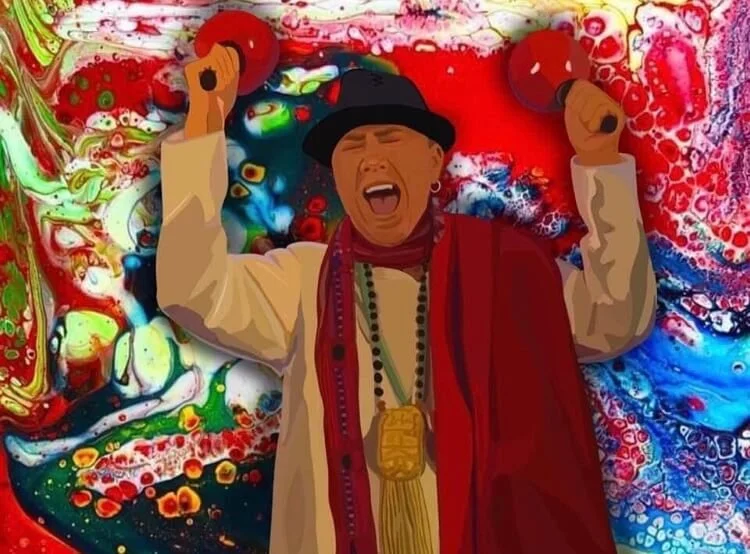
Tupili Lea Arellano moved to Oakland from the South West very intentionally in 1981 to get sober, find queer community and learn. A Mexican, Indigenous, queer, disabled elder and medicine worker with Two Spirit Urban Medicine Practice, Tupili shares stories about the group Mujerio that formed in Oakland, performing as Carlitos, and creating a lesbian building on 63rd and San Pablo.
Hear the Story
Read the story
-
My name is Tupili Lea Arellano. I am a 70 year old Mexican, indigenous, queer, disabled elder. I was born in Silver City, New Mexico in 1952. We went to Tucson, Arizona and I spent 26 years of my life in Tucson, Arizona. I knew very early that I was very different in many, many ways. I noticed that I liked girls in that kind of special way. It was still in those days that we had to wear dresses to school and stuff. And for me, that was cross-dressing and it was very wounding, very wounding. And I got the message that I was going to have to live silently in some very important ways, and that I was going to have to play the role of this gender that I was not. I fit into the box, the binary box, as best as I could.
I had a neighbor, Cathy, my best friend. She was also butch. What some people then might have called tomboy. And I didn't even hear tomboy, I think, till I was in the second or third grade. So I said, okay, it looks like people are okay with that tomboy word. We had older brothers, both of us. We used to sneak our older brothers' clothes and put them on. And we had little girlfriends from elementary school and we used to take them to the Dairy Queen and buy 'em $0.05 ice cream cones. And $0.05 was a lot then, let me tell you. But I already knew how to make money. I was already making my own money in second grade.
I came out to my family in my early 20s because when I went to my mother wanting to tell her when I think I was about 18, she asked me to wait. She asked me to wait because I told her it's an intense conversation I want to have with you about myself. And she said, in the most loving, sweet, tender way you'd ever imagine, 'Mija,' which means my daughter, 'Mija, can we wait a little while? Because I'm going through stuff that's really intense.' And I said, 'Of course, Mom.' And sure enough, in my early 20s, she called me on the phone and she said, 'Mija, come over. I'm ready to hear everything.' You know, it makes me want to cry. It was just so loving and so tender. And I went over there and she said, 'I've known this about you and I love you so much. And you don't ever have to worry about that with me, ever.' My dad took a little bit longer. He really got upset. And he asked me never to say the word lesbian in his house again. And I said, Dad, I'm going to say it whenever I want to say it. That's who I am. And you and me are going to communicate about it. And you know what? He became one of my best allies. He became one of my best allies supporting me, my relationship. Because he had already gotten to know before I came out to him, he had gotten to know my friends. My parents liked to have food and dancing and drinking, and a lot of my friends would come. And then one by one he'd say, 'What about so and so?' I said, 'Yes, Dad. That person is also LGBTQ' or gay, whatever we were talking then. All of them. He already loved them. How could he not love who I was, eventually.
I definitely am a lesbian, a butch dyke, but I'm also on the trans spectrum. It's like looking at a jewel, like let's say we look at a faceted ruby, that's my favorite – one of my favorite stones. And every facet can be a gender, and there can be 36 facets on that jewel. Because we see them now. Those of us who were in the streets, because I was in the streets a bunch, we made it safer for our younger people. And a lot of them don't know it. Because they're saying, 'well, people have educated themselves, straight people have educated themselves.' And I just addressed it yesterday said, 'honey, do not give the straight people the credit. It's people like me that literally bled with broken nose, a cut forehead, things like that. Is why you enjoy the ability to hold hands in Berkeley.'
I had a vision and a dream, and my great grandmother came to me and told me this was the place where I would heal and grow and have what I needed, especially safety. And I thought to myself, here's this indigenous woman from the Tarahumara mountains of Mexico, what does she know about the Bay Area? Well, you know what, ancestors know everything and see everything. It was 1981 when I landed here, you know, so I was 28 years old. And at the top of my list was to get sober. What it was like when I first arrived is, first of all, I just want to say I drove the biggest truck you can drive legally. I was unstoppable. I was such a roll and tumble strong dyke. And here I come to the Bay Area in 1981. Ooh, I am in paradise. One of the first things I did was march in the sober contingent at the San Francisco Gay Pride. So what happened here was I knew that it was going to take me a minute to get sober. And so I went to the bars. And I was depressed about going to the bars because I was really committed. But I knew that I'd meet people, but I also knew that I couldn't ask myself to put down alcohol, which was the medicine that was helping me with my physical and mental health, it was helping me with anxiety and everything. So I met people there. I did get kicked out of a bar once for being drunk. It was Ollie’s in Oakland. Ollie’s is a famous old lesbian bar. What's really interesting is that's now a Science of Mind church where I studied. So there I was dancing back there and carrying on and drinking and everything and then a few years later here I'm going to this church, the Science of Mind church. I would just laugh when I'd be sitting in church, I said I used to raise hell back here in the sanctuary where I'm sitting.
I got sober after a year I had been here. It took me a year to finally stop, stop. And I haven't had a drink, it's been almost 41 years.
-
Oakland at that time, the city internationally that had the most lesbians per capita. Oakland, do you hear me? Oakland! Oooo was I thrilled about that. A small group of us got together and formed a group called Mujerio. Mujerio, that word means a tremendous gathering of women, like a crowd of women. It was a social group, so we could have that kind of social space, but it was also very political. We had a little newspaper and I wrote for the newspaper. It was Ask Marimacha, which means ask a dyke. And they sent questions to me. One of the popular questions was about sex, love and romance. How do we attract healthy girlfriends? I would drop little seeds in there about sobriety. Because I was already sober. I would talk about self-love and self-care. And we're to hook up and connect with people and what bars we're not welcoming to women. That newsletter, it wasn't online because that wasn't happening yet. I had a little typewriter. I had an electric typewriter, oh, how exciting. And we'd hand them out. We'd go out to the bars dancing and stuff, we'd hand out those newsletters because we were always recruiting. I had a big, beautiful home that I rented. So we gather there some of the time. I want to mention Yolanda Noriega, who was part of Mujerio. She provided party space for us for years. She had a big house in Oakland up near the hills. She threw the best parties. So the house party's so important. Every month there was at least one rent raising party from the lesbian of color community.
The women in Mujerio use things like marimacha, malflor, the things that were in Spanish or indigenous language. Marimacha means a very powerful flower or a very powerful butterfly. And there was some that were calling themselves dykes, but we had to – there was periods of getting comfortable with the language. Look at what we have now. And we're still creating because we're still not super conscious about gender. You know, people are saying, well, now we have three genders. I go, Are go no, no, no. There's a spectrum of gender that you would not believe. And I carry multiple of those inside of myself.
Two spirit basically means male-female. It's another binary. I'm not binary. I definitely carry the divine feminine and the divine masculine, but I carry other things too. I have an inner gay man who is a drag queen. And I did performance, his name is Carlitos. I did performance with him to educate people about gender. And one butch that was a good friend of mine came up to me one night after my performance in a very kind of sensuous, sexy way. Said, 'You should do femme more often.' And I go, 'I can't do femme. I'm not a femme. That was a gay man you saw who's a drag queen. I said you weren't paying attention.' [Laughs] Because I'm an educator and a teacher, and that's what I do with my performance art. Carlitos did all his performing in Oakland. I was in Salvation Army downtown Oakland one day, and they used to have a boutique there, ooo, where all the good stuff was. So I went in there and I found a hand sequined –hand-sewn, hand sequined – red glittery dress. And it weighed about, I'm not kidding, it weighed about 15 pounds. I grabbed me that dress darling. And I hadn't even done drag yet. Carlitos, who lives inside of me, grabbed that dress and we found a pair of low, high heels – because I wasn't going to do anything crazy – and a matching purse. A red Tina Turner wig. Ooooh, honey. One of my main songs was the Tina Turner song, the song about 'sometimes we like to do things nice and easy. And sometimes we do 'em rough.' [singing] 'Left a good job in the city.' So it's 'working for....' And it was that song about the river, you know. So slap those little heels on the floor. My legs look fabulous in that dress and all of that. It was fun. It was so much fun. I mean, I just loved it. It was a ceremony. It was sacred to me, was medicine for me.
-
I got to manage an apartment building on San Pablo and 63rd. And I talked him into letting me turn it into a lesbian building. And he let me. I just put the word out. I said, this is where this building is. We're turning it into like a lesbian apartment building. And I had a list before the building was ready. I think there was eight apartments because I was thinking about this and counting them. We shared food and had meetings. God, lesbians loved to have meetings. It lasted two years, which was really good. And I made sure that it was diverse. I made sure that everybody was there. There wasn't an abundance of white women. They fought me on that because everyone wanted to live there, not everyone, but lots of people. Because we had it going on. We had a garden and everything. We had an elder there and she taught us how to grow the best collards in the world. And we had parties and we had a big backyard, private fenced and everything. Even though I was very young, I was 30 years old or something, I've always been kind of like an elder. So I brought young dykes in there that needed help and stuff and helped them. It was one of the best things I ever experienced. Loved it, loved it, loved it. And we lived in the neighborhood, it was right near the Black Muslim Bakery. And there was a lot of stuff going on there. Some of it very good and some of it not. It was just a very alive neighborhood. That building is still standing.
My main work is to pass on what I've been given and what I've learned and what I've gathered. So really pass it on because I've got some really good information from being here 70 years and being a dedicated student. My community is my wealth and I've always known that relationships were the most valuable things we could have. So I have a really big community here and I was very visible. Not so much now with COVID, but always at the events. Many of the events, at the dances at Oakland Gay Pride, which is my favorite Gay Pride, by the way. It's my favorite. I want to mention Kin Folkz, was one of the people that made that happen, be born, and one of the people that kept it going. Kin Folkz is one of the most powerful medicine people, medicine carriers, in Oakland.
I have found now that I'm an elder, that there's not a ton of people thinking about us. A very brutal piece of colonization that's very obvious is people are forgetting elders. We're not sexy to them anymore. I don't feel shame about needing help and getting help. And anybody that has any kind of a brain knows that I'm in the situation that I'm in because of capitalism, because of racism, because of patriarchy, not because of any mistakes that I made. I moved 11 times in the last year. DJCC which is Disability Justice Culture Club, and they help disabled people survive and elders survive. And they have really helped me for the last couple of years, just a tremendous amount.
The core of my practice is decolonization of the mind, because if you decolonize the mind, everything else follows. Our worlds are made up of our thoughts. And I studied deep, deep, deep. Science of mind and quantum physics with African-American women, there were some of my best teachers. They taught me to find the gratitude in anything. Just continue one day at a time to do the best that I can to survive, but also to be of service and to pass on what I've been given.