
Melanie
Location: Montclair Women’s Club (1650 Mountain Blvd, Oakland)
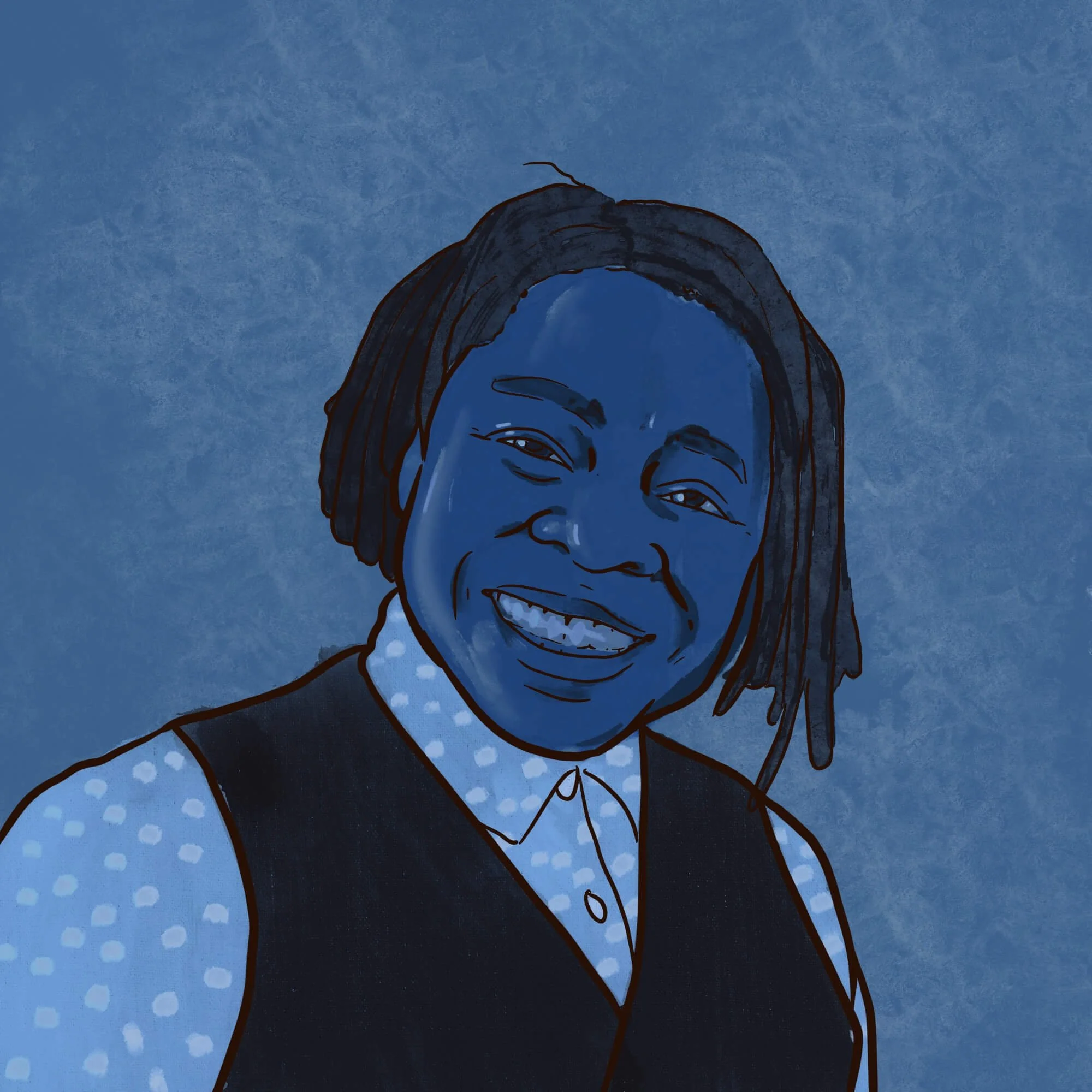
“People ask me sometimes, ‘What are you doing when you’re not doing music?’ And I say, ‘I don’t understand the question, because it’s all connected to me.’” Melanie DeMore self describes as a “vocal activist.” Born in New York in 1954, Melanie’s life in music has traveled from the Bronx to Alaska, Texas, New Mexico, and Oakland.
A founding member of the Grammy-nominated vocal ensemble Linda Tillery and the Cultural Heritage Choir whose rehearsal home was the Montclair Women’s Club, Melanie is also a Redwood Records recording artist. Melanie has long been a vital presence in the feminist and lesbian women’s music circuit as a performer, educator, and conductor.
Note:
Check out the archival project Because of a Song that documents the 1970s feminist and lesbian music movement, focusing on its roots in Oakland, California
Hear the Story
Read the story
-
My name is Melanie DeMore. My pronouns are she, he, they, we. I am a vocal activist. In other words, like my students always say, 'this is a Ms. DeMore-ism,' I use my voice as a weapon of mass connection. I was born June 23, 1954 in New York City. I'm the oldest of 5. We lived in the South Bronx in a really, really dangerous, scary neighborhood. I'm the only one my age group that I grew up with that's still alive. Most of them were dead by the time they were in their 30s. And my father joined the Army, the Military, to get us out of New York. And he really didn't like it. Because when he entered into the Army, he was in the last all colored unit before the Army was desegregated. And so him and my mom just decided we got to do something. We got to get our kids out of here. And that's what they did. And we ended up being stationed to Anchorage, Alaska. Daddy went off to Vietnam. We went from Anchorage, Alaska, to San Antonio, Texas. My dad's back from Vietnam. He's an absolute mess. We're in San Antonio, we've never lived anywhere in the South. It's hotter than the holy hinges of hell. And there are crickets crunching and it's constant 'cheee-cheee-cheee' all the time. The trees, everything covered in crickets. I was like, you have brought me to fucking hell [laughs]. I just thought, from Anchorage, Alaska, to San Antonio, Texas – we had moved to Anchorage in January and moved to Texas in July – oh, it was insane.
I started high school in 1968. I went to an Army Military high school. We had maybe 135 kids and I would say 130/34 of us had fathers or brothers who had been or was in Vietnam. And what's really interesting, I'm at an Army high school, and we were really staunchly anti-war. Because we knew what was happening. We would go to Fort Sam Houston, which is the base there, and to the hospital. I'm like maybe a sophomore. And we would write and talk to these young guys, some of them quadriplegics. We saw stuff that nobody else ever saw. They weren't that much older than us. So that's the kind of stuff I was doing when I was high school, and that's not what most people were doing. So we saw things that most people didn't see. I was very, very anti-war and anti-military in a different sort of way. Just because I saw how they just didn't care for them. Like the people, individuals, cared for each other but the institution sends them there and just abandon them. And I saw all that stuff. You know, it's nothing like sitting at a bedside of somebody who's 19 years old with no arms and no legs. And thinking why? For what? And they lay their lives down for an organization that doesn't give a shit about them. And I've seen it time and time again. They come home and they're just fucking destroyed. You know, my dad, when he came home from Vietnam, we were staying in this $3 motel, was horrible. It was hot and humid and smelly and it was terrible. And my little brother Eric went outside and the door slammed. My father hit the ground and started shaking, trembling. My mom pulled us all to the side and said, 'children, you have to be really quiet around your daddy. Daddy is very fragile' or something like that.
Anyway, I must have been 14, 15. Fell in love with this girl, didn't know what was happening. And this is like 1968, 69 or something. One day my mom says to me, 'sweetie,' and I say, 'yes, ma'am?' She said, 'Have you ever thought about yours and Grant's relationship?' Well, no. She said,'think about it.' So I'm thinking, I'm thinking. All of a sudden I was like, oh no, this is just not right. I mean, I freaked out. I called up Grant, I said, 'Grant, do you know what kind of relationship–' she said, 'yeah.' I said, 'that ain't right.' And so a couple of weeks go by. My mom sees me, she says, 'I haven't seen Grant around in a while.' And I said, 'Well mom, you told me to think about my relationship and I did, and it's a sin.' And she said, 'Baby, the only sin is if you have the chance to love and you don't.' I said, Wait. What? I said, 'Why did you tell me that?' She says 'because when you were aware of what you're doing, you have more choices.' I'm like, What? My mind was blown. That's how my mother was. My mind was blown. And my mother and father were also in theater. They started one of the first black theaters when we lived in Alaska. So they just didn't have any trip about it. And I was like, what is this?! And then my dad, I remember I wanted to get my hair cut really short. And this was really – it was a time when you would go into a place and they would not do it. We're not doing that. So my dad took me to the base. And he took me to a barber. And my dad was like a sergeant or something, but he outranked this private. And he said, 'My daughter wants a short hair. Cut her hair.' So I had support and not really understanding that I had that.
-
I wanted to do all of it. My degree is actually in flute, piano and music history. And there are people I went to college with who've never heard me sing. And I'm known mostly as a singer, as a vocalist now.
I came to the Bay, I was living in Taos, New Mexico, before this, which is my heart's home. Taos is where my heart feels the most at home. I was the main musician in Taos. That's where I met Odetta there in Taos. I opened up for Joshuite Junior, opened up twice for John Prine there. So I had done all that. I have a thing that when I come into a community, I want to be a part of it. It's like people go and say, well, I don't know anybody. Well get out there. Get out there. You want to know what's happening? Talk to people. So I was very involved, it's the same thing that happened here. And so I came here because I needed to be in more of an urban place. And I had done a couple of concerts here at Mama Bear's. So I ended up coming here, didn't know what was going to happen. And I was staying with a friend who lived next door to Elizabeth Min, a brilliant conductor directing the choir at Mills. She said, 'What do you do?' And I told her and she said, 'Well, can you do some work with them?' I said, 'Sure.' So I did that. She also was the artistic director of the Oakland Youth Chorus. So I became a California Artist in Resident working with the Oakland Youth Chorus, unbelievable. 14 to 21 year olds. There's no other organization like the OIC. I was with them for 10 years. And then it's been music ever since, since I've been here.
And then, of course, in all that time I was in the Cultural Heritage Choir, founding member with Linda Tillery. And the original band had, Elizabeth Min was our music director. And Linda came up with this concept that would help preserve traditional African-American roots folk music. So she called together these folks. And so it was Louise Robinson, who was an original member of Sweet Honey in the Rock. Michelle Jaques, Rachel Bagby, who was a member of Voicestra with Linda. Voicestra being the great acapella band from Bobby McFerrin. Had some of the best singers on the planet. Judith Casselberry from Casselberry and Dupree. Vicki Randel. Rashida Oji. Our interpreter Shirley Johnson {CHECK}, who was the interpreter for Sweet Honey. Rhonda Benin That's when we first made our first thing was at Michigan Women's Music Festival. And of course when we came back and Linda decided it should go on and it was just Bay Area people. And there was 6 of us and then it went down to 5. I was with them for 18 years and that completely changed my life. Being in that band completely changed my life. And being in the company of such extraordinary black women. It was another one of those things that changed the trajectory of my life. The power of doing something that is so culturally specific and just being rooted in that tradition which spans so many things was really, really important.
And we were very proud of the fact that we were based in Oakland. Our rehearsal home was the Montclair Women's Center. Boo made us like lifetime members. So that was our home, that's where we would go and rehearse. We always rehearsed on Monday nights and we would rehearse in the room that had a fireplace and the colors were gorgeous in the room. Was such a real center for lesbian artists and everything else. And she did all kinds of weddings and things there, too so it was really a community center in that way. First of all, it was really elegant, beautiful stage. It was very comfortable in the way she had it set up. You would have folks cooking in the kitchen. I used to go there and just help Boo out. I used to be like the greeter. So it gave me a chance to wear a tuxedo, which was always good for me. It was just a real comfortable place to be. CHC was doing a show at Montclair and the lights went out, all the electricity went down. So we sat on the edge of the stage and sang like that for folks. So it was very intimate. And I mean, you just had a blackout. And so we thought, well, the show must go on. So we did that, which was really, really wonderful. There is real attention to detail in terms of making places for people to feel comfortable and connected. You know, that was the thing I loved about Montclair. That's what I loved about Mama Bears. And in anything that I do at First Congo, it just had this warmth about it.
And I a story I remember, this just cracks me up, is that we're at rehearsal. This was a daytime rehearsal. So we were at rehearsal at Linda's house. And she's sitting there. And she's just really twitchy. We're like what the hell's going on? So we're going on and finally I said, 'Linda, what is going on?' She said, 'We've been nominated for a Grammy!' And she said, 'But we can't say anything about it. The official announcement is tomorrow at 2.' And it was so exciting. We had made an album with Taj Mahal and Eric Bibb, a children's album. It was really exciting to have that feeling. I actually, I'm up for, this is my third time I've been on a Grammy nominated album. And I am the elder on this last project. And I said to them, I said, 'not winning is not necessarily losing.' I said, because you get to be a Grammy nominated artist for the rest of your life. But being with the CHC and going through that, oh my gosh, it was very, very, very exciting.
-
Being in the Bay Area, everybody was here! So because you had Redwood Records was here in Oakland and Olivia was here. It started in L.A., but they didn't really become Olivia, Olivia until they moved to Oakland. So they were all here. So it was a hub. Oakland, a hub of women's music and everybody ended up coming through here. It's amazing who lives here. And so there's an opportunity to play here and to be with other folks.
And coming to the Bay Area was – who knew to get my whole solo thing going. That's how I got into the women's music circuit. You know, even though I had done little things here and there. That's how I got to Michigan and that's how I got to National. That's how I started doing all these different things. And that was the thing about being in the women's music circuit at that time, 70s and 80s, there were producers all over. So we could play anywhere. I was out on the road a lot there in between teaching and all these other things.
Because I was a Redwood recording artist. I was one of the last recording artists signed to Redwood. Redwood Cultural Work, it was the other women's music label. Was started by Holly Near. What I loved about Redwood, they produced some incredible concerts. As a Redwood recording artist, I ended up opening for Laura Nyro.
And Redwood was amazing. They brought all kinds of folks in here. I was really happy to be with Redwood. Because I had been asked to be a part of Olivia a long, long time ago, but I felt it was a better fit for me with Redwood. Because my music is accessible to everybody, no matter who you are, what you are, or what you call yourself. And that's how I like it to be. I like to make it so that everybody has a place at the table. That you can see yourself. And that's been important to me throughout my teaching with my kids. And if I write songs for my student, I want them to be able to recognize themselves in that music. Because when you're not seen, that's when shit gets weird. Being with Redwood, I could just be me and how I wanted to be. So Redwood was badass, bad to the bone.
That was one of the things that that that is really been – it was really the women's community and people like Susan Freundlich when they started having interpreters. That was not something that was normal for concerts. Now it's normal. But that was started in the women's community. Saying we want to make sure that everybody can participate. Now I'm one of the few musicians, I used to travel with my own interpreter because I thought that that was important. And also I never had my interpreter stand over there, they're right next to me. Because I think it's like everybody should be, 'what is this?' Everybody should be able to look in the same direction and enjoy it in the same way. And that's how I've always been.
And the level of collaboration here, the different things I've gotten to do with different kinds of musicians and different organizations, is extraordinary to me. And I've gotten to be a soloist and a composer. I was the conductor for Voices the Bay Area Lesbian Choral Ensemble in the early 90s. And working with that group of women and singers, that organization is still going on now. There was so much to be able to do here. And again working with the Oakland Youth Chorus and privileged at this. But I wrote the music for the documentary about Joel Gomez. OLAC, Old Lesbians for Change, I'm actually the keynote speaker for the next gathering coming up. I'm like, sure, okay, what the heck? Those kinds of things and I'm going to be at National coming up, National Women's – I am doing a stick pounding workshop, I'm directing the festival choir and I am doing a concert. So I'm doing all those things. But that whole network of things that happened. So we are connected to each other. We're doing some deep shit out there. And I think that's really, really important. And on a whole different level.
One of the things, one of the things is that people ask me sometimes, what are you doing when you're not doing music? And I say, I don't understand the question because it's all connected to me. All of it. There's no difference in me sitting here with you, it's part of my musical landscape. There's no separation to me. And that was one of the things that happened to me, because even with my mom and dad, they sang, they did theater. It wasn't like separate things. It was just it was our life. So that's why it's part of the reason why I keep doing my music and keep doing stuff that I do. I mentor a lot of people and I always tell my students. I'd say, 'you know what? Use the gifts that you've been given right where you are.' It's so much simpler and so much more productive to let things ripple out and try to pull everything toward you because you can't do that. It's got a ripple out. What can you do right where you are in this moment? And that's the most important thing. That's the most important.