
Kozi
Location: Frick Middle School (2845 64th Ave, Oakland)
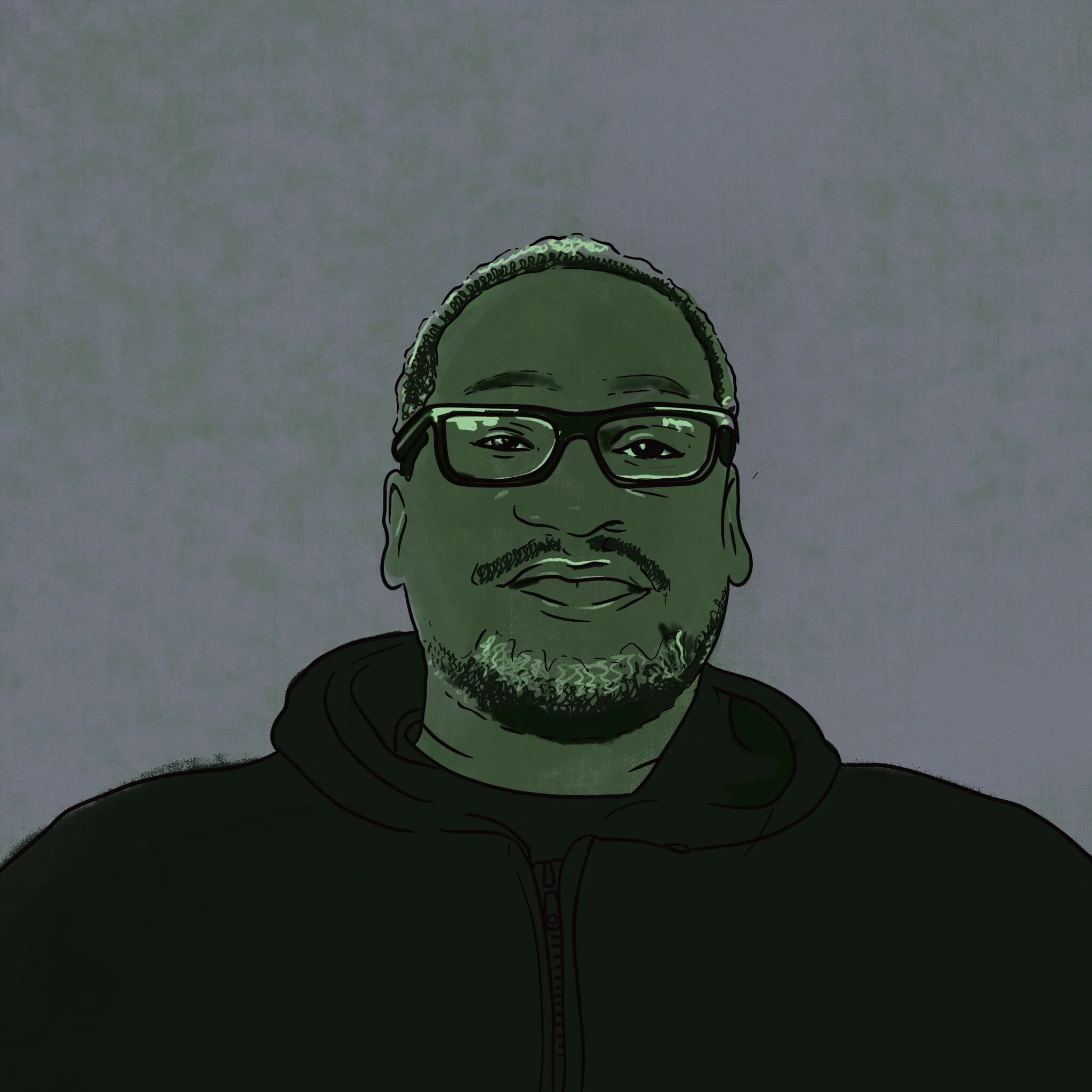
Born in San Francisco in 1955, Kozi moved with family to Oakland, growing up on 73rd and East 14th (now International Boulevard), across from Frick Middle School, where he attended. From transitioning out of Catholic school into public school, to coming out in high school and taking day trips to Los Angeles, Kozi carries vivid stories of growing up in Oakland. His journey later took him to New York City, where he lived through the AIDS crisis, incarceration, and a singing career. Today, Kozi serves as Programs Outreach Coordinator at PEERS and is the founder and director of The Traveling Voice and The Sounds of Joy.
Read the story
-
I am Kenneth Kozi Arrington. Everyone knows me as Kozi throughout Alameda County and the Bay Area. I am a 67 year old African-American male. I also identify as a gay male. I was born in San Francisco and I now live in Oakland, California. My parents, they did the best they could to send us to parochial school. So I went to Catholic school and pretty much hated it, especially as I got older. When I found that the things that they were teaching were things that I was experiencing and by their narration I was going to hell because of the thoughts and feelings I was having, even as a young kid. Because I knew in the first, second grade that I was different. I knew somehow that I was more attracted to the little boys than the little girls even then. I didn't have a name for it or was not able to articulate that, but I knew how I felt. And then I knew that the lessons were preaching hellfire, brimstone and damnation for folks who had those types of thoughts and feelings. So let me tell you this: I am 67. So when I was a kid growing up isolated and insulated in San Francisco, going to a parochial school where my brother and I were probably three of – we were called colored then, hmmm – anyway three blacks kids in the old school, I thought I was a little white girl, like with the little red hair and freckles like the Wendy's. My mother told me, first of all, you are not a little white kid. Second, that I was not a little white girl. My mother said no. And that thing between your legs makes you a boy. Makes you a boy. You're not a girl. Like what? Mom, what are you saying? [Laughing] Stop it. Why are you doing this to me? So I learned a few hard lessons that day.
And when we moved to Oakland, we moved to a home that was on 73rd Avenue right off East 14th, it was called then. They call it International today. It'll always be East 14th to me. And we lived a few houses off the corner. At that time, the Black Panther Party headquarters was right at 73rd and East 14th. So I grew up seeing and hearing about figures like Huey Newton, Angela Davis, Stokely Carmichael, all of those people that were right in my neighborhood feet away. Having to walk from 73rd & East 14th to 82nd & Bancroft to the new Catholic School, St Benedict's, every day back and forth, that's a long way. My brother and I would trek in our uniforms that made us targets for all of the public school kids. And we had to pass by four public schools to get to where we were going. Oh, adventurous. Yes [laughs].
My neighborhood, in the street that I was raised on, right across the street from Frick. Because what I haven't shared is my family was the first African-American family on the block. We were put into a predominantly white, Portuguese and Italian neighborhood at the time, back in '64. So we were the first African-Americans on the block. So I have really strong ties to that experience in Oakland. And I'm really sad that just recently my father chose to sell the family home and moved to Concord in a condo. I'm no longer able to go to the family home. I'm no longer able – that was my ground-ation. My roots were right there. Watching the neighborhood go from white, Portuguese, Italian to what it has become today, which is 99%, I would say, African-American. And to watch the property go down and to watch all that has happened, destroyed the illusion of my happy childhood. So I feel really displaced. I always thought that I, maybe after my father passed, I would move into that house and fix it up. But that's not going to happen. I feel like the rug has been really kind of pulled out from underneath me. So I don't have a foundation anymore. A place that I will always call home. Isn't that what we all want?
-
But what was really culture shock was to go from Catholic school into the public school system, which happened in the ninth grade. I ended up going to a public school called Frick Junior High School, which was directly across the street from our home. I mean, I could walk out the door, walk 50 steps and be in the school grounds, directly across the street from the gate. Culture shock, talk about culture shock. To go into a public school where there was cussing and fussing and fighting and locker rooms. Oh my God, no. No [laughing] what in the hell is all this, I can't! Please lord, no. Get me out of here. Fremont High School was pretty interesting. I guess in high school, is when I was really able to name it and claim it. I came out in high school because I was in a creative writing class. Teacher was wonderful. I'm sure the teacher was gay. We had an assignment where we had to do a speech in front of the class. And I found this article. The title was 'Was Jesus Gay' or 'Was Jesus a Homosexual,' whatever the term they were using. And I just came out and I said, These are things that you all have been saying about me, that I have been accused of being all this yadda, yadda, yadda. I am who I am and I stand in who I am. And so basically you get over it. I just owned it. But they were not ready for that. That was a really bold thing for, I guess, anyone to say in the way that I said it so emphatically. They weren't ready. Consequently, of course, I got an A, not on that assignment, but in the class. And I think life even got even easier after that because I'm sure the word went around. I kind of grew fearless because I had been called all the names and in doing so I was able to rise above, lift my head up high and be who I was and go through high school basically unscathed. It was pretty cool. I would leave with my friends and we would go to San Francisco and find our way into the gay bars. Even back then, while we were still in high school. And then somehow make it back to the terminal before it closed at midnight to catch that last bus back to Oakland. Catch that last 57 bus. The 57 bus was the one that would take me home. Because I didn't really need to study a lot because I was kind of brainy. I never had to worry about passing a class. So some days the three of us, the same bus that would take me to school, if I take it in the opposite direction, [laughing] it took us to the Oakland airport. Where at the time, we could fly roundtrip to Los Angeles for $15. So sometimes I'd leave in the morning, we'd meet, and we'd go to the airport, fly to L.A. and fool around and party all day and still make it home in time for my curfew that night. Just fast huh? There was an airline called PSA, which we nicknamed Poor Sissy Airlines [laughs]. Oh my Gosh. That was my experience in high school, going to the clubs, I had no business in the clubs, just a little mouse trying really hard to be a rat, learning how [laughing]. Oh, I was color coordinated, okay. If I had on light blue jeans, I'd have on a light sky blue shirt. And at that time, we were ascot, so little scarves around our neck with the little ring. I was just too cute [laughs]. And of course, I had to have my hair. Every hair in place. I was impeccably groomed. Those days, the platform shoes were out [laughs]. So I'm already 6'2", or was then, so here I was even taller when I put on my going out clothes or whatever. I was trying to be as fashionable as my parents could afford for us to be. And that worked out pretty well. And like I said, my friend Eric, his parents sewed and he learned to sew and make clothes. So we were always pretty much looking the bomb [laughs]. In '72 or '73 I got it for best dressed. I got it for best afro. I had hair from here to there and back again.
Okay. I was really talented and still am, so I was able to excel in a number of ways academically, creatively. I was in like the madrigals choir and the drama club, all of those types of things where I was able to express myself and come out of my shell even more. Music and song has always been a part of my life. I remember singing my first solo in kindergarten.
Let me tell you that I also come from a family of musical people. My father was and is at the age of 90 something right now today, still a jazz singer. His mother was a music teacher, a piano teacher. So from educated slaves on down the line through the generations, I grew up listening to my father's rehearse around the house, jazz stuff. My first experience with gospel music wasn't until I left Catholic school and went to Frick Junior High School where they had a gospel choir and that was like, wow. That was mind blowing. Because I grew up singing Bach and Beethoven and Schubert and Franz and listening to classical music and attending the ballet and the orchestra in San Francisco. Those were the field trips that we went on in the Catholic school. So I had this whole other experience of learning languages and singing in different languages as a kid to now being exposed to ethnic kind of music and of course being exposed to jazz all my life. So yeah, I remember singing my first solo in kindergarten, and that's when I realized and everyone realized, Wow, this kid can sing, right? I was so good, in fact, that I was offered or I went to an audition for what was at the time the San Francisco Boys Choir. Elite, right? I don't know if they had any African-American or colored kids back there in the early '60s, but I made the audition. But it was unaffordable for my parents, maybe by design, after I made it. I don't know. I never will. But I know I was good enough to do that. I was good enough to be in the high school a cappella group, the Madrigals. I was good enough to do musical theater. So, yeah, it's always been what I have been able to ground myself in. And it's a real wellness tool because if I'm feeling sad and if I'm feeling blue or any of that, I can always call upon my music and my voice to make myself feel better and lift myself up. It was only in the realization that in doing so that I was elevating other people and that other folks were really enjoying my music. And the messages that I brought that I said, Yes, this is what I want to do for forever. This is a God given gift. It would not be a good thing for me not to exploit it to its fullest.
-
Not having a real direction, I found myself as a student at Alameda College, Laney College, Merritt College. So I went to all of the local Peralta school colleges for one reason or another, for one class or another, at one time period or another, never really graduating or getting a degree in any of them because opportunities kept coming up. Oh, they're doing something over here. Do you want to fly over here? You want to do this or. You know? And I was like, yeah, I can always go to school but when opportunities like that knocked, I felt it was my obligation and duty to say yes to them and step out of my comfort zone, not be afraid to travel, not be afraid to experience new people, places and things. Knowing that because of who I felt I was inside that I would be okay. Okay. This is what happened. So I was in New York City, early '80s, and I was working in the theater. And this is when GRID came along. Gay related immune disease, soon to become known as HIV and AIDS. So doing theater every day, every week, there was another, 'did you hear about?' story. 'Did you hear about so-and-so? Did you hear about – did you hear about?' And the people all around me were dying. Some of them really suddenly from this gay related immune disease. And I realized I said, I'm going to some of the places, I'm exhibiting some of the same behaviors as these people. So how soon is it going to be before I succumb to this very same thing? And weighed heavily on my mind. The costume designers were falling. The actors, the musicians, everybody involved in theater. There was always almost every week, if not every day, another, 'did you hear about?' Story. Well, I got to the point where I was really tired of hearing that, and I was like, this is probably going to be my fate as well. So let me do something about it now. You know, the saying, 'out of sight, out of mind'? Well, I decided that I would basically disappear from the scene. So that if and when my time did come, I would have been so far removed for so long that there would be less likely a chance of anyone getting that, 'did you hear about?' story. So for 15 years I ceased to be. I was alive. I was existing. But I was not thriving. I had embarked on a path of self-destruction, self-loathing, self-hatred, drug use, which was something that I was never really into. For 15 years, I was in this state of limbo, or basically hell, where I was pretty much waiting to die. Waiting. And it didn't happen. After me knowing literally by first name hundreds of people to die of AIDS, for some reason that I was still here. Why? There must be a reason. There must be a reason. And so for that reason, I got involved with the Alameda County Public Health Department Office of AIDS.
I became a PLW, a people living with HIV/AIDS Committee member. I went on from that committee to become co-chair of the – oh, wow. I hate to mess up the name. It was the overarching committee that the PLWA was a subcommittee of. And so that was in public health. And then I had an incident, a fall from grace, if you will. And I ended up incarcerated myself, which is something I never thought would happen to me. Never thought it would happen, and it should not have. But because of certain circumstances, I wound up incarcerated for a relatively short period of time. After having never been in trouble all my life, I found myself incarcerated at the age of 49. And I actually went to a prison. The thing that saved us, because I am HIV positive at California Medical Facility, which is in Vacaville, California, the HIV inmates had single man cells. Perfect. Because I don't know how it might have been if I would have had to share a cell with another person. So that saved me in and of itself that I was placed in the HIV unit. And there was something about that too, because in the mess hall – the lunch room – once you came out of that cafeteria, all the inmates that went to the right were going to general population or gen pop. If you went to the left, you were headed toward the HIV units. So people were able to tell a lot about you just from the direction you went during that. I was blessed even in prison. And I'll tell you how. I've always been a vocalist. That's always been what I do. I have done and still do to this day. The first opportunity I got that I was able to go to chapel. I went and I observed. All I wanted to do was to sing for these people. That's all I wanted to do. Lift my voice and give the message of words, of encouragement, that sort of thing. So one day after the service was over, I found the chaplain and I said, 'Hi, I'm new here, and all I want to do is sing. Is there a possibility I would ever be allowed to join this praise and worship team or sing for the inmates?' Two weeks later, he paused. Sang, performed my first a little bit, said an uncomfortable pause behind your lights. Inmates eventually saying, okay, go over there and talk to that. You know, I mean, this went well. That, of course, was another inmate who was injured, course, had to live. This is amazing. But that was the first. And I went over and I introduced myself from doing that to make to not sit on the transition team for all four of the Sunday services. The morning and the afternoon and the evening service. So prison, although it was a horrible thing to have happened to me, was one of the most learning experiences that I have had. And I'm a better person for having experienced that after incarceration. Pretty much still homeless at the time. I have been homeless as well. A person let me stay with them, and one Sunday morning they were getting up and they were going to a service or a church of some sort. And so one day I said, 'Can I go with you?' It was that day, 2004, that I was introduced to the Oakland Center for Spiritual Living. And that's up in the Oakland Hills. I am a member of that center today. I joined the choir there where I quickly became one of their featured soloists. I started singing on fourth Sundays at the center and I have been there for eight years now. On fourth Sunday, me and my group or just me by myself, since I'm the founder and director, I am the traveling voice and they are the sounds of joy. And we're still together today.